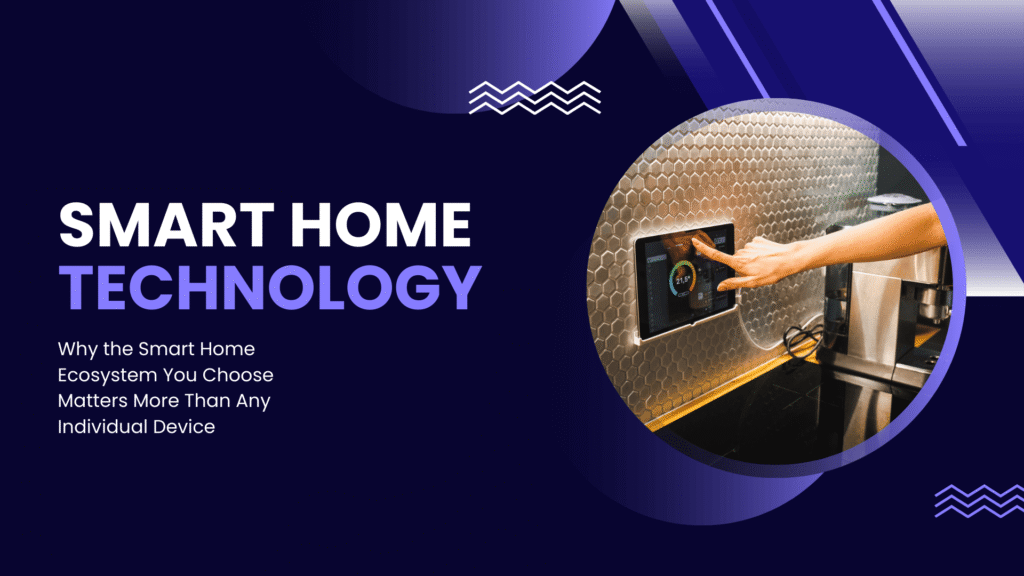
Smart home technology purchases follow a pattern that most buyers recognize only in retrospect — the individual device that seemed like a straightforward, low-commitment entry point into home automation gradually reveals itself as a vote for an ecosystem whose compatibility requirements, platform dependencies, and long-term support trajectory will shape every subsequent smart home decision for years. The smart speaker purchased because it was on sale, the video doorbell chosen for its hardware features, and the smart thermostat selected for its energy savings all carry platform affiliations that either integrate smoothly with each other or require workarounds, bridging devices, and the kind of technical patience that consumer products are not supposed to demand. Understanding that the ecosystem decision is the most consequential smart home decision — more consequential than the quality of any individual device within it — is the perspective that most smart home buyers develop after making several purchases and only some buyers develop before their first one.
What a Smart Home Ecosystem Actually Is
A smart home ecosystem is the platform that connects individual devices — lights, locks, thermostats, cameras, sensors, appliances — into a coordinated system that can be controlled through a unified interface, automated through shared rules and routines, and expanded through devices that speak the same technical language. The major ecosystems — Amazon Alexa, Google Home, Apple HomeKit, and the newer Matter standard that has attempted to create cross-platform compatibility — each provide the hub, the voice interface, the automation engine, and the device compatibility framework that determines what works together and how well.
The ecosystem is not the individual devices — it is the connective tissue between them, and the quality of that connective tissue determines whether the smart home functions as the seamlessly automated environment that the category promises or as a collection of individually functional devices that require separate applications, separate setup processes, and separate voice commands to control. The difference between a well-integrated smart home ecosystem and a collection of uncoordinated smart devices is the difference between arriving home to lights that turn on, a thermostat that has adjusted to your preferred temperature, and a security system that disarms automatically — and arriving home to manually trigger each of these actions through different applications because the devices do not share a common platform language.
Why the Major Ecosystems Differ in Ways That Matter
The three major established ecosystems — Amazon Alexa, Google Home, and Apple HomeKit — have meaningful differences in their design philosophy, device compatibility breadth, privacy approach, and the depth of automation capability they provide, and these differences produce genuinely different experiences that map better or worse onto different household priorities and technical comfort levels.
Amazon’s Alexa ecosystem has the broadest device compatibility of the three major platforms — more third-party devices are certified to work with Alexa than with any competing platform — and the Echo hardware line provides entry points at price tiers that make the ecosystem accessible at any budget level. The breadth advantage comes with a complexity trade-off — the Alexa app’s interface reflects the scale of what it attempts to manage, and the setup and troubleshooting experience for complex automations requires more technical engagement than Apple’s more curated approach demands. Amazon’s business model — built around commerce and advertising in ways that Apple’s and increasingly Google’s are not — has produced privacy concerns that households with strong data sensitivity should weigh explicitly rather than accepting as the default cost of ecosystem breadth.
Apple’s HomeKit ecosystem offers the strongest privacy posture of the major platforms — processing automation logic locally on Apple devices rather than in the cloud — and the tightest integration with Apple hardware in a way that produces a genuinely seamless experience for households that are comprehensively within the Apple device ecosystem. The trade-off is the narrowest third-party device compatibility of the three major platforms, reflecting Apple’s historically more rigorous certification requirements, and the dependency on Apple hardware that makes the ecosystem’s premium experience conditional on continued investment in Apple devices. Google Home sits between these poles — broader device compatibility than HomeKit with a stronger AI integration than Alexa through its Google Assistant foundation, but a platform history of service discontinuation that has made the smart home community’s trust in Google’s long-term platform commitment less solid than the underlying technology warrants.
Why Matter Changes the Calculation Without Resolving It
The Matter standard — a cross-platform protocol developed by the Connectivity Standards Alliance with participation from Amazon, Apple, Google, and a wide range of device manufacturers — represents the most serious attempt yet to address the fragmentation that has made ecosystem lock-in the defining challenge of smart home technology. Matter-certified devices can work with multiple major ecosystems simultaneously, removing the compatibility barrier that previously forced buyers to choose a single platform and accept its constraints. The protocol’s adoption has been growing since its 2022 launch, and the range of Matter-certified devices has expanded substantially enough to make it a genuine factor in current purchasing decisions.
What Matter does not resolve is the ecosystem differentiation that exists above the compatibility layer — the automation logic, the voice assistant quality, the application interface, and the device management experience that each platform provides on top of the common connectivity standard. A Matter-certified smart bulb works with Alexa, HomeKit, and Google Home — but the automation that turns it on when you arrive home runs through whichever platform’s logic engine you have chosen, and the quality of that automation experience still reflects the platform’s specific capabilities rather than the universal compatibility standard. Matter makes device switching less painful and reduces the risk of single-device purchases creating ecosystem lock-in — but it does not make the ecosystem choice irrelevant, because the experience layer above the compatibility standard remains platform-specific.
How to Choose the Ecosystem That Serves Your Situation
The ecosystem choice that produces the best smart home experience is the one aligned with the devices already present in the household and the priorities that the smart home is intended to serve. The household comprehensively invested in Apple devices — iPhones, iPads, Macs, Apple TV — accesses HomeKit’s most compelling integration advantages without additional hardware investment and experiences the privacy-first automation logic that Apple’s local processing approach provides. The household with Android phones, Google services, and a comfort with cloud-based processing finds Google Home’s integration more natural and more capable than the alternatives. The household that prioritizes device variety, budget flexibility, and the broadest possible third-party compatibility finds Alexa’s ecosystem breadth most practical even at the cost of the premium integration experience that Apple’s more curated approach provides.
The practical starting point for any smart home build is the voice assistant device that serves as the ecosystem’s primary interface — an Amazon Echo, a Google Nest speaker, or an Apple HomePod — followed by the category that provides the most immediate quality of life return in the specific household. Smart lighting is the category that most consistently delivers immediate, tangible improvement and the broadest device compatibility across platforms. Smart security — locks, cameras, and sensors — is the category whose ecosystem integration matters most for the automation logic that makes security meaningful rather than merely monitored. Building the ecosystem from these high-return categories before expanding to the longer list of connectable devices produces a foundation whose integration quality can be assessed before the commitment deepens.
Conclusion
The smart home ecosystem decision matters more than any individual device because it determines the compatibility, integration quality, and automation capability of everything that follows it — and reversing a poor ecosystem choice after several purchases have been made within it is considerably more expensive and disruptive than making the right choice before the first purchase. The Matter standard has reduced but not eliminated the consequences of the ecosystem decision by providing cross-platform compatibility at the device level while preserving the platform differentiation that makes the experience layer above it meaningfully different across ecosystems. Choosing based on the devices already present in the household, the privacy priorities that the household holds, and the specific smart home capabilities that will deliver the most immediate value produces an ecosystem foundation that the subsequent device choices can build on rather than fight against.