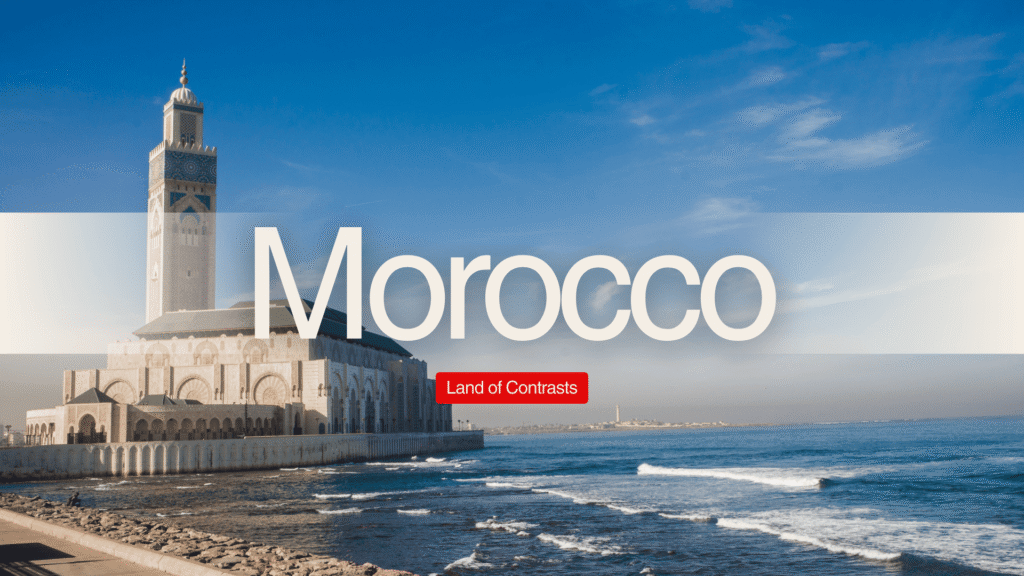
Morocco has always been a destination with genuine allure — the medinas, the desert, the Atlas Mountains, the food, the particular quality of light in coastal cities that photographers have been drawn to for generations. What has changed in recent years is not the country itself but the convergence of factors that have moved it from a destination that serious travelers knew about and casual travelers occasionally considered into one of the fastest-growing tourist destinations in the world. Record international arrivals, infrastructure investment that has made the country more accessible from more origins, a cultural moment driven partly by global sporting visibility and partly by a travel community that has discovered and amplified what Morocco offers — these forces have combined to produce a tourism surge that the country’s hospitality infrastructure is actively expanding to accommodate. Understanding what is driving the growth, and what the country actually offers the traveler who goes now, provides more useful guidance than the headline numbers alone.
The Accessibility Improvements That Have Opened the Door
Morocco’s geographic position — closer to Europe than most travelers who have not looked at a map realize, and increasingly well-connected to North American and Middle Eastern origins — has been amplified by airline route expansion that has made reaching the country more straightforward and more affordable than it was a decade ago. Low-cost carriers operating within Europe have added Moroccan routes that make Marrakech, Casablanca, and Fez accessible from major European cities at prices that position Morocco as a competitive alternative to European destinations rather than a more expensive long-haul consideration.
Direct route expansion from North America has reduced the barrier that a connecting flight once imposed on transatlantic travelers considering Morocco. The psychological and logistical difference between a direct flight and one requiring a European connection is significant enough to affect destination consideration at the planning stage, and as direct options have become more available, the segment of the North American travel market that actively considers Morocco has grown correspondingly. The country’s airports have received infrastructure investment that has improved the arrival experience in ways that matter for first impressions — and in travel, the arrival experience shapes the entire trip’s emotional baseline in ways that are difficult to recover from when they go poorly and that compound positively when they do not.
What Morocco Offers That Few Destinations Can Match
The experiential case for Morocco rests on a combination of elements that individually exist in other destinations but nowhere else assemble into the particular combination the country provides. The imperial cities — Fez, Marrakech, Meknes, and Rabat — each carry a depth of historical and architectural layering that is accessible without the crowds that equivalent historical depth attracts in European destinations. The medina of Fez, a UNESCO World Heritage site, is among the best-preserved medieval urban environments anywhere in the world, and moving through its labyrinthine lanes past working tanneries, artisan workshops, and mosques whose foundations predate most European cathedrals produces an experience of historical immersion that few destinations can replicate at the same intensity.
The Sahara Desert is the element that travelers who have not been to Morocco most underestimate in its impact. The transition from the medina cities through the High Atlas Mountains and into the pre-Saharan landscapes of the Draa Valley and the erg dunes near Merzouga compresses an extraordinary geographic and cultural range into a drive or a short flight. Spending a night in the desert — in a camp that ranges from basic to luxurious depending on budget and preference — under the particular darkness of a sky without light pollution produces an experience that travelers consistently identify as among the most affecting of their lives, regardless of how widely they have traveled previously. This accessibility of a genuine desert experience within a few hours of a major international city is a combination that no other destination in the world offers in quite the same form.
The Food Culture That Has Not Received the Attention It Deserves
Moroccan cuisine occupies a position in the global food conversation that substantially underrepresents its actual quality and complexity, and travelers who arrive with limited expectations in this area consistently find them exceeded in ways that become a defining feature of the trip. The culinary tradition that produces tagines of slow-cooked lamb with preserved lemon and olives, bastilla that layers pigeon or seafood with almond and cinnamon in pastry, harira soup that navigates the intersection of legumes and spice with a complexity that rewards repeated encounters, and the street food culture of Djemaa el-Fna in Marrakech where dozens of stalls compete for attention with grilled meats, snails, and fresh-squeezed juices has developed across centuries of Berber, Arab, Andalusian, and sub-Saharan African influence into something genuinely distinctive.
The mint tea culture deserves specific mention as a social and sensory experience that travelers encounter repeatedly and uniformly describe as one of Morocco’s more disarming pleasures. The ritual of tea preparation and the hospitality it represents — offered in riads, in shops, in private homes — is not a performance for tourists but a genuine social practice whose warmth is available to any traveler who accepts it without suspicion and engages with it on its own terms. The quality of interaction it enables, across language barriers and cultural distance, is one of the things about Morocco that travelers find most difficult to convey to people who have not experienced it and most miss when they return home.
The Practical Realities That Shape the Experience
Morocco’s tourism surge has produced the familiar consequences that rapid growth delivers to destinations that absorb it unevenly — the most visited sites at peak times carry crowd densities that reduce the quality of the experience they are famous for, and the hospitality infrastructure in the most popular areas has developed a commercial intensity that requires navigation rather than passive enjoyment. Djemaa el-Fna in Marrakech is simultaneously one of the world’s great public spaces and, at peak evening hours, an environment that demands the specific kind of alert engagement that exhausts travelers who approach it with the relaxed openness they might bring to a quieter destination.
The quality of the riad accommodation that has become Morocco’s most distinctive hospitality offering varies enough across the range of options available to make research worthwhile before booking. The riad model — a traditional townhouse organized around a central courtyard, typically converted into a guesthouse — provides an experiential authenticity that international hotel chains cannot replicate and that at its best is among the most distinctive accommodation experiences available anywhere. At its worst, a poorly maintained or dishonestly represented riad produces a stay that colors the entire trip negatively. The investment of time in reading recent guest accounts and selecting accommodation with established track records rather than optimistic photography is repaid in the quality of the base from which the rest of the trip is experienced.
Conclusion
Morocco’s emergence as one of the world’s most visited countries reflects the convergence of genuine experiential quality with improved accessibility, a cultural moment that has amplified awareness of what the country offers, and an infrastructure investment that has made the visit more straightforward across a wider range of traveler origins. The destination rewards the traveler who brings the curiosity and engagement that a place this layered and this different from most Western travelers’ daily experience requires — and who does enough preparation to navigate the commercial intensity of the most popular areas toward the authenticity that exists alongside it. Morocco is not a destination that reveals itself passively. It reveals itself to the traveler who goes looking, and what they find consistently exceeds what they expected to find.