
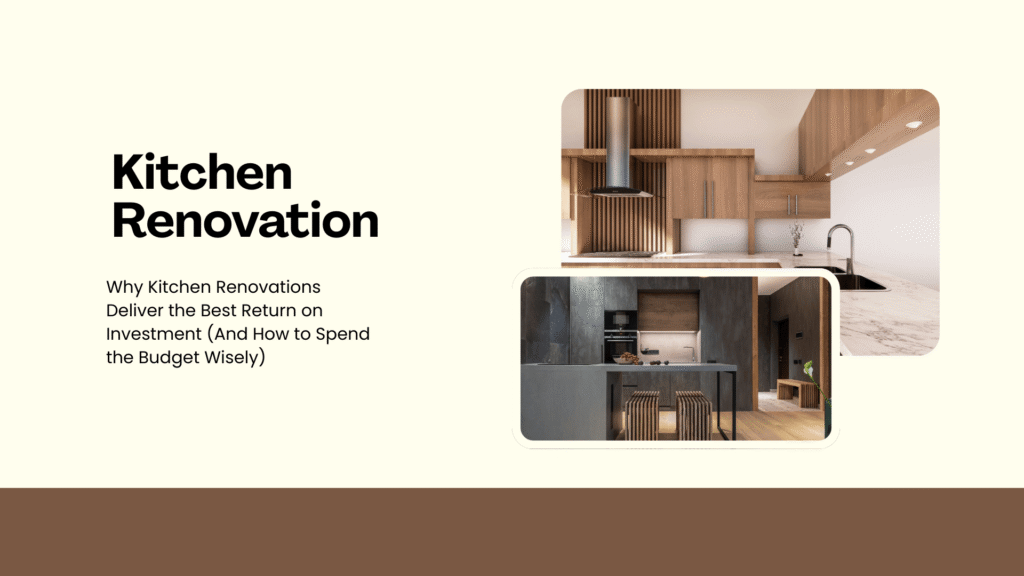
Home renovation decisions carry a particular kind of financial pressure that most other spending categories do not — the expectation that the money spent will return as increased home value, either at resale or through the quality of daily life the improvement enables. Not every renovation delivers on that expectation equally, and the gap between the projects that produce strong returns and those that cost significantly more than they add in value is wide enough to make the allocation decision genuinely consequential for homeowners who are working with finite renovation budgets. Kitchen renovations have occupied the top tier of return-on-investment rankings across real estate and renovation research for long enough that their position there is not a coincidence of a particular market moment — it reflects structural reasons why buyers value kitchen quality consistently and premium-price it reliably, and understanding those reasons provides the foundation for spending the renovation budget in ways that capture the return rather than missing it through the specific choices that separate high-return kitchen renovations from expensive ones that underperform at resale.
Why Kitchens Generate Returns That Other Rooms Do Not
The kitchen’s structural advantage in renovation return calculations rests on the role it plays in home purchase decisions relative to every other room in the house. Real estate research consistently finds that the kitchen is the room most frequently cited by buyers as the primary driver of their purchase decision and the primary source of reservation when it falls short of expectations. This is not arbitrary — the kitchen is the room that buyers interact with mentally during the purchase evaluation more intensely than any other, projecting their daily lives into the space and making judgments about whether that projection is appealing or not. A kitchen that supports a positive projection of daily domestic life sells the house in a way that no other room replicates with the same reliability.
The functional centrality of the kitchen — it is the room most used, most visible to guests, and most directly connected to daily quality of life in ways that other rooms are not — means that its condition affects the entire home’s perceived value in a way that is disproportionate to its square footage. A dated or dysfunctional kitchen depresses a buyer’s assessment of a home whose other rooms are in excellent condition in ways that the reverse does not apply — a renovated secondary bedroom does not elevate a buyer’s assessment of a home with a poor kitchen. The asymmetry means that kitchen investment addresses the most consequential perception variable in home valuation more directly than any alternative renovation allocation.
The Renovation Scope That Maximizes Return
The relationship between kitchen renovation spending and return on investment is not linear — it does not follow a pattern where more spending produces proportionally more return. The research on renovation returns consistently finds that midrange kitchen renovations — defined roughly as comprehensive updates that replace outdated elements and modernize the space without installing the highest-cost finishes and appliances — produce stronger percentage returns than the major renovations that install premium everything and push total costs into ranges that the neighborhood’s ceiling value cannot fully support.
The midrange renovation that produces the strongest returns focuses on the elements that buyers see and experience immediately: cabinet fronts or full cabinet replacement, countertop materials, appliance updates to current stainless or panel-ready standards, hardware replacement, and backsplash. These are the elements that form the visual impression of the kitchen within the first seconds of entering the space and that determine whether the buyer’s psychological response is positive or requires convincing. Flooring, lighting, and fixture updates complete the refresh of the space’s overall feel without requiring structural changes that escalate costs without proportional return.
What the return data consistently shows is that the premium over midrange finishes — the difference between quartz countertops and marble, between good appliances and professional-grade, between solid wood cabinets and custom cabinetry — is rarely recaptured in sale price in markets where comparable homes were not built with those finishes at that price point. Installing finishes that are significantly out of step with the neighborhood’s price ceiling and competitive set produces an expensive kitchen that buyers appreciate without paying a premium commensurate with what it cost — a phenomenon real estate professionals describe as over-improving for the market.
Where to Spend and Where to Exercise Restraint
The allocation decisions within a kitchen renovation budget are where the difference between a high-return project and an expensive disappointment is made, and the principle that guides them is consistently the same: allocate toward the elements that buyers see and experience, exercise restraint on the elements that buyers do not notice or cannot distinguish from less expensive alternatives in a showing context.
Cabinets represent the largest budget allocation in most kitchen renovations and the decision that most consequentially affects both cost and visual impact. Full cabinet replacement is the highest-cost option and produces the strongest visual transformation — but cabinet refacing, which replaces doors and drawer fronts while retaining the existing box structure, produces a visual result that most buyers cannot distinguish from full replacement at a cost that is substantially lower. For cabinets in good structural condition, refacing represents one of the most favorable value propositions in kitchen renovation. New hardware — pulls, knobs, and hinges — is among the highest-return renovation investments available at any budget level, changing the perceived quality of the entire cabinet installation at a cost that is a small fraction of any other cabinet intervention.
Countertops are the surface that buyers touch and evaluate tactilely in ways that floors and walls are not, and the material decision here has genuine return implications. Quartz has displaced granite as the dominant countertop material in renovated kitchens at the midrange price point, offering consistent patterning, low maintenance requirements, and a premium appearance at a price point that buyers have come to expect in updated kitchens. Spending above the quartz tier — toward natural stone varieties that require sealing and careful maintenance — adds cost without adding the perception of value that buyers at most market levels assign proportionally.
The Mistakes That Reduce Return Despite High Spending
The kitchen renovation mistakes that consume budget without generating proportional return share a common characteristic: they direct spending toward categories that cost a great deal but are invisible or irrelevant to buyers at the moment of decision. Structural changes that do not meaningfully improve function or flow — moving a sink from one wall to another without a layout improvement that buyers will immediately perceive, or opening a wall that requires electrical relocation without producing a transformation in the space’s openness — generate significant cost from plumbing, electrical, and drywall work that does not translate into visible improvements buyers can value.
Premium appliance spending above the level that the home’s price point and competitive market support is the single most consistent source of renovation budget that does not return at resale. A kitchen with a $15,000 professional range in a home where comparable sales were achieved with standard appliances does not sell for $15,000 more than those comparable sales. The appliance spending that generates return is the replacement of clearly dated appliances with current stainless or integrated alternatives — the elimination of the negative rather than the installation of the extraordinary.
Conclusion
Kitchen renovations deliver the best renovation return on investment because buyers value kitchen quality more consistently and price it more reliably than any other home feature — and because the elements that drive that valuation are specifically the ones that midrange renovation budgets can address effectively without the diminishing returns that premium spending introduces. The allocation decisions that maximize return are oriented toward visual impact and buyer experience rather than material exclusivity, toward the elimination of dated elements rather than the installation of extraordinary ones, and toward the competitive standard of the specific market rather than the absolute ceiling of what kitchen renovation can cost. Spending wisely within that framework produces returns that justify the investment. Spending above it produces an expensive kitchen that the market cannot fully price.