
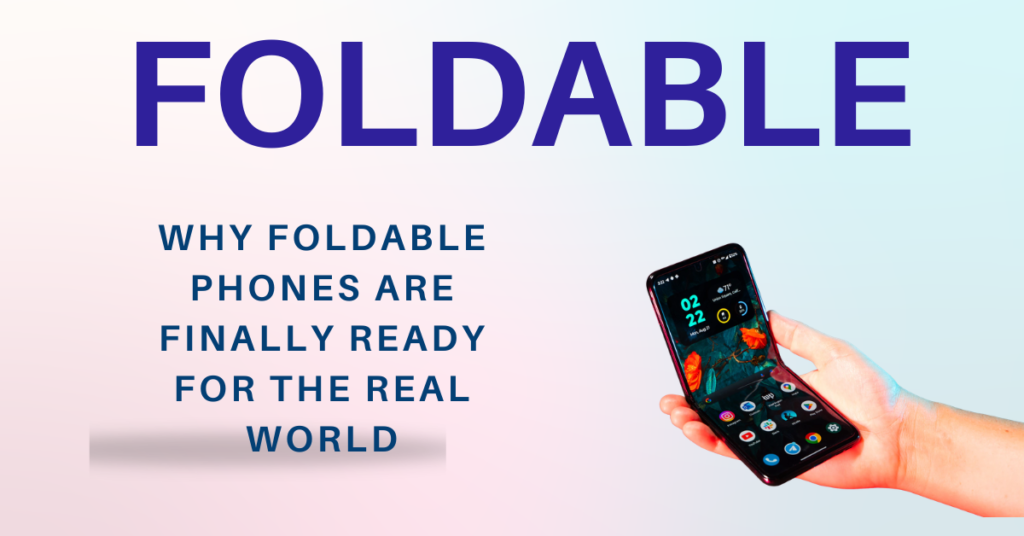
Foldable phones arrived with the kind of fanfare that tends to precede disappointment. The first generation devices were genuinely impressive as engineering demonstrations and genuinely problematic as consumer products — screens that creased visibly and failed unexpectedly, hinges that accumulated dust and debris, software that had not caught up to the novel form factor, and price tags that asked early adopters to pay a significant premium for the privilege of being the first to encounter the problems. The technology press covered the failures with the same energy it had applied to the initial reveals, and the category developed a reputation for being perpetually almost-ready without ever quite getting there. That characterization is no longer accurate. The foldable phones available now are categorically different products from the ones that earned the skepticism, and the case for them has moved from theoretical to practical in ways that deserve a more updated assessment than the early reputation allows.
What Has Actually Changed to Make Foldables Viable
The improvements that have transformed foldable phones from fragile novelties into genuinely reliable daily devices have accumulated across several generations of hardware refinement that received less attention than the initial launches. Screen durability is the most foundational improvement. Early foldable displays used ultra-thin glass composites that were vulnerable to pressure, impact, and the mechanical stress of repeated folding cycles in ways that created real-world failure rates the category could not sustain commercially. Current generation displays use significantly more durable materials — Samsung’s latest flexible glass formulations, combined with improved protective layers and refined hinge mechanisms — that have produced crease visibility and durability profiles that are measurably better than what any previous generation delivered.
Hinge engineering has advanced in parallel. The mechanical complexity of a hinge that must fold hundreds of thousands of times over a device’s lifespan while maintaining precise alignment, preventing debris ingress, and creating a satisfying tactile experience with each open and close was a genuine engineering challenge that early products solved imperfectly. Current hinges from Samsung, Google, and OnePlus incorporate water resistance, tighter debris sealing, and refined tolerances that have reduced the hinge-related failure modes that defined early category perception. The devices are not indestructible — no smartphone is — but they are durable enough that daily use no longer requires the anxiety that accompanied owning first-generation foldables.
The Form Factor Advantage That Justifies the Premium
Understanding why foldable phones command a premium requires engaging honestly with what the form factor actually delivers beyond novelty. The book-style foldable — devices like the Samsung Galaxy Z Fold series and the Google Pixel Fold — offer a smartphone display on the outside cover and a tablet-scale display on the interior. This is not a gimmick in the way that early critics characterized it. It is a genuine dual-purpose device that replaces both a smartphone and a tablet in a single pocket-sized package for users whose workflow benefits from occasional access to a larger screen.
The productivity applications are concrete. Reading and annotating documents, running multiple applications in split-screen configurations, video editing previews, and any task that benefits from screen real estate beyond what a standard smartphone provides become meaningfully more capable on a foldable interior display. For professionals who currently carry both a phone and a tablet — or who regularly find themselves working around the limitations of a phone-sized screen — the foldable consolidates that function into one device with a size penalty that is modest relative to the capability it adds. The clamshell foldable — devices like the Samsung Galaxy Z Flip and Motorola Razr — makes a different value proposition: a phone that folds to half its closed size, fits more naturally in a pocket, and offers a distinctive form factor without the tablet-mode functionality of its larger counterpart.
Who Should Actually Buy One Right Now
The honest answer to who should buy a foldable phone requires separating the people for whom the form factor solves a real problem from those for whom it is an expensive answer to a question they were not asking. The strongest candidates are professionals and power users who genuinely use both a phone and a tablet regularly and would benefit from consolidating those devices — writers, designers, consultants, and anyone whose mobile workflow involves document review, multitasking across applications, or frequent video consumption on the go. For this group, the premium over a standard flagship smartphone is partially offset by the tablet they no longer need to carry separately.
Early technology adopters who have been watching the category mature and who have the budget to absorb the premium without it representing a financial stretch are the second natural audience. The devices are now reliable enough that adoption is no longer a gamble in the way that first-generation foldables were, and the ownership experience is sufficiently differentiated from standard smartphones to justify the interest for someone whose primary purchase motivation is experiencing what the leading edge of mobile hardware currently looks like.
The buyers for whom foldables are not yet the right choice are equally worth identifying clearly. Anyone whose primary concern is value per dollar spent will find that current foldable pricing — still carrying a significant premium over flagship alternatives — does not represent optimal allocation of a smartphone budget. Anyone with a history of dropping and damaging phones should consider that foldables, while improved dramatically in durability, remain more expensive to repair than standard smartphones when they do sustain damage. And anyone whose daily smartphone use does not push against the limitations of a standard screen size will find that the foldable’s key advantage is solving a problem they do not actually experience.
Conclusion
Foldable phones have earned a reassessment that the category’s early reputation has made slower to arrive than the actual hardware improvements justify. The durability issues that defined first-generation products have been substantively addressed. The software ecosystem has matured to take advantage of the larger interior display. The form factor delivers genuine productivity advantages for users whose workflows benefit from them. The premium remains real and remains the most significant barrier for most buyers — but for the specific user profiles that foldables are designed to serve, that premium now buys a reliable, capable, and genuinely differentiated device rather than an expensive experiment. The category is ready for the real world. Whether the real world is ready for it depends almost entirely on which real world you happen to live in.