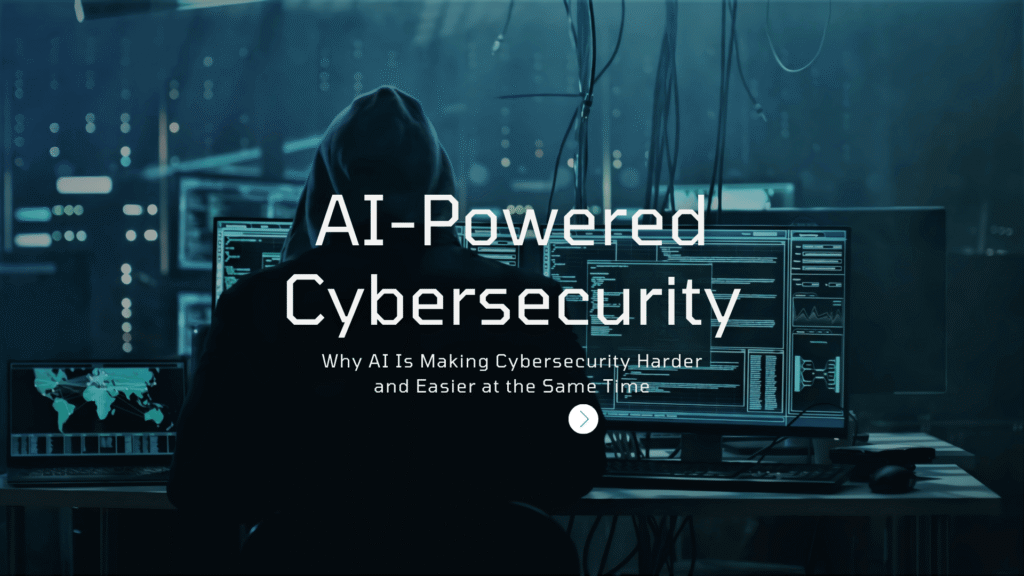
Cybersecurity has always been an asymmetric contest — defenders must protect every vulnerability while attackers need only find one, and the resources, time, and creativity available to each side have never been equal in the ways that would make the contest fair. Artificial intelligence has entered this contest on both sides simultaneously, amplifying the capabilities of defenders and attackers in ways that have not resolved the asymmetry but have changed its character significantly. The organizations and security professionals who understand how AI has shifted both sides of this equation are better positioned to make the investments and develop the practices that the new threat landscape requires. Those who understand only that AI is making cybersecurity better — or only that it is making threats worse — are missing half of a picture that requires both halves to navigate effectively.
How AI Has Strengthened the Defensive Side
The defensive applications of AI in cybersecurity address the fundamental limitation that has historically made human-only security operations inadequate at the scale that modern enterprise environments require — the volume of events, alerts, and anomalies that security systems generate exceeds the capacity of human analysts to review, triage, and respond to in the timeframes that effective defense requires. A large organization’s security infrastructure generates millions of log events per day, and the signal-to-noise problem of identifying genuine threats within that volume has historically meant that security teams either missed real threats in the noise or exhausted themselves chasing false positives that consumed the attention that genuine incidents deserved.
AI-powered threat detection addresses this volume problem by applying machine learning models trained on historical attack patterns to the continuous stream of security events — identifying the behavioral anomalies, network traffic patterns, and system activity sequences that indicate compromise with a speed and consistency that human review cannot match. The endpoint detection and response platforms that have become standard in enterprise security environments use these models to identify suspicious processes, lateral movement attempts, and data exfiltration behaviors in real time rather than in the retrospective forensic analysis that previously followed a breach’s discovery. The time between initial compromise and detection — the dwell time that determines how much damage an attacker can cause before being identified — has been reduced in organizations with mature AI-powered detection capabilities in ways that are measurable and significant.
How AI Has Strengthened the Offensive Side
The same capabilities that make AI valuable for detecting threats at scale make it valuable for generating and executing them at scale — and the barrier to deploying AI-enhanced attack capabilities is lower than the barrier to deploying AI-enhanced defenses, a disparity that reflects the asymmetry between the resources required to attack and those required to defend. The most immediately consequential offensive AI application has been the dramatic improvement in social engineering attack quality that large language models have enabled. Phishing emails — the entry point for the majority of ransomware infections, business email compromise frauds, and credential theft attacks — were historically identifiable by the grammatical errors, awkward phrasing, and generic content that reflected the limitations of non-native English speakers conducting attacks at volume.
AI-generated phishing content has eliminated these signals. Large language models produce grammatically perfect, contextually appropriate, personalized content that targets the specific individual with references to their organization, role, recent professional activity, and the particular social engineering approach most likely to produce the desired response — at a cost and scale that previously required significant human effort to approximate. The spear phishing attack that once required hours of manual research and writing per target can now be generated in seconds for thousands of targets simultaneously, and the quality of the resulting content makes the behavioral detection that security awareness training has historically produced increasingly insufficient as a defense.
The New Threat Categories That AI Has Created
Beyond improving the execution of existing attack types, AI has created categories of threat that did not previously exist at scale and whose implications for organizational security extend beyond what traditional security frameworks were designed to address. Deepfake audio and video — synthetic media that realistically replicates specific individuals’ voices and appearances — have moved from a technical curiosity to a documented attack vector in the form of voice cloning fraud, where AI-generated audio replicating an executive’s voice is used to authorize fraudulent wire transfers or extract sensitive information from employees responding to what they believe is a legitimate internal request.
The velocity at which AI can identify and probe vulnerabilities has accelerated the window between a vulnerability’s disclosure and its exploitation in ways that have compressed the patching timelines that organizations need to prioritize. AI-assisted vulnerability research tools that can analyze code, identify exploitable weaknesses, and generate proof-of-concept exploits have made capabilities that previously required highly skilled human researchers accessible to attackers with substantially lower technical sophistication — a democratization of offensive capability that has expanded the pool of actors capable of conducting technically sophisticated attacks.
What This Means for Organizations and Individuals
The practical implications of AI’s dual role in cybersecurity are different for organizations with dedicated security resources and individuals navigating personal digital security without professional support, but they share a common foundation — the threat landscape has changed enough that security practices calibrated to the pre-AI environment are inadequate for the threats that AI has enabled, and updating those practices requires specific adjustments rather than a general increase in vigilance.
For organizations, the most urgent adjustment is the recognition that the human verification behaviors that social engineering attacks depend on exploiting have become more important rather than less important as AI improves the quality of social engineering content. The business email compromise attack that requests an urgent wire transfer, the voice call that impersonates an executive requesting immediate action, and the vendor communication that requests a payment method update are all attack vectors that AI has made more convincing — and the defense against more convincing social engineering is not better spam filters but the procedural verification requirements that confirm the legitimacy of high-stakes requests through channels independent of the communication being verified.
For individuals, the most significant behavioral adjustment is the recalibration of the trust signals that AI-enhanced attacks have compromised. The grammatical quality, personal specificity, and apparent legitimacy of a communication are no longer reliable indicators that it originated from a trustworthy source — AI can produce all of these characteristics for malicious communications as easily as it can for legitimate ones. The verification habit of treating unexpected requests for sensitive information, financial action, or credential entry with skepticism regardless of how legitimate they appear — and confirming their legitimacy through independent contact with the purported sender — is the behavioral defense that AI-enhanced social engineering has made more important than any technical security tool for the majority of individuals.
Conclusion
AI has made cybersecurity simultaneously harder and easier in ways that are real rather than rhetorical — genuinely improving the detection and response capabilities that defenders deploy while genuinely improving the quality, scale, and sophistication of the attacks those defenders face. The net effect on security outcomes depends on which side of the equation an organization or individual has invested in more thoroughly, and the current state of adoption suggests that offensive AI deployment has outpaced defensive AI investment in ways that are producing the attack success rates that headline breaches reflect. Understanding both sides of the equation is the prerequisite for making the specific investments and behavioral adjustments that the new landscape requires — and treating AI’s cybersecurity impact as uniformly positive or uniformly negative produces a response calibrated to a half-truth rather than the more complicated reality.