There was a time when the idea of a machine reading human emotions belonged firmly in science fiction. Today it is an active and rapidly advancing field of artificial intelligence research with real products, real applications, and real implications for how you interact with technology every day. AI systems are being trained to detect frustration in a phone call, recognize stress in a written message, and identify sadness in a facial expression with an accuracy that is improving faster than most people realize. Understanding what this technology can and cannot do — and where it is already being quietly deployed — is increasingly relevant to anyone who uses a smartphone, interacts with customer service, or sits behind a steering wheel.
How Machines Are Learning to Read What You Feel
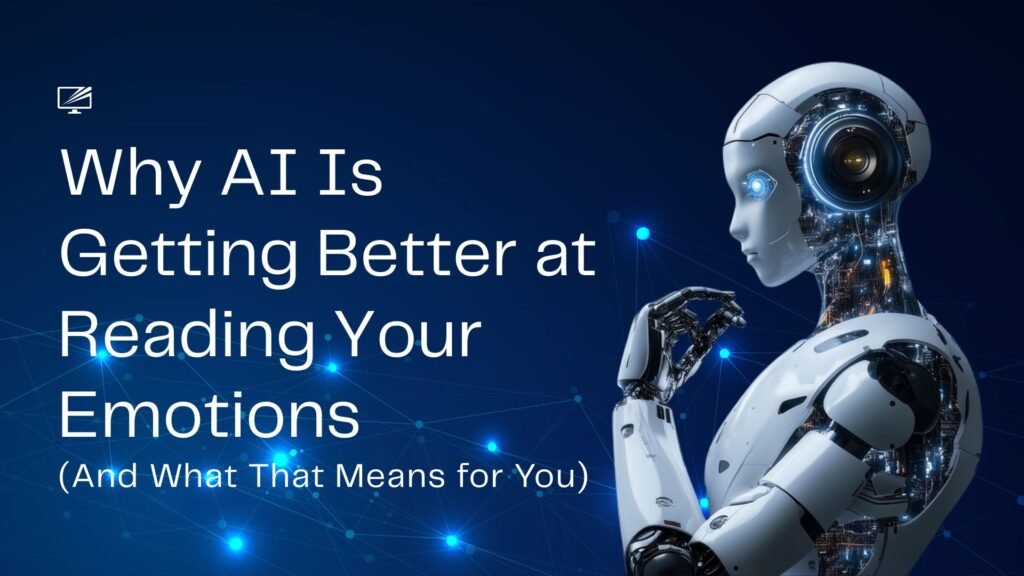
Emotion AI, sometimes called affective computing, works by training machine learning models on enormous datasets of human emotional expression across multiple channels. Facial recognition systems are trained on thousands of images and video clips tagged with emotional labels, teaching models to associate specific muscle movements — the slight tension around the eyes, the downward pull at the corners of the mouth — with underlying emotional states.
Voice analysis systems work similarly, identifying patterns in pitch, tone, tempo, and micro-variations in speech that correlate with emotional states beyond the meaning of the words themselves. Text-based sentiment analysis has matured to the point where AI can detect not just whether a message is positive or negative but gradations of frustration, urgency, sarcasm, and emotional distress within the same sentence. The combination of these channels — what researchers call multimodal emotion recognition — produces systems that are considerably more accurate than any single input alone.
Where This Technology Is Already Being Used
The deployment of emotion AI is already further along than most people appreciate. Contact centers are among the earliest and most widespread adopters, using voice sentiment analysis to monitor customer calls in real time — flagging rising frustration, alerting supervisors when conversations are deteriorating, and in some systems automatically adjusting the tone or routing of the interaction based on detected emotional state.
The automotive industry has invested heavily in driver monitoring systems that use in-cabin cameras to detect drowsiness, distraction, and stress. Several major manufacturers now include these systems as standard safety features, with the AI trained to recognize when a driver’s emotional or cognitive state creates a safety risk before the driver consciously registers it themselves. In healthcare, emotion recognition tools are being piloted to support mental health screening, detect early signs of depression from speech patterns, and help therapists track patient emotional responses during sessions. The technology is moving from controlled research environments into everyday products faster than public awareness of it has kept pace.
The Accuracy Problem That Cannot Be Ignored
For all its progress, emotion AI carries a fundamental challenge that its most enthusiastic proponents do not always lead with: human emotional expression is deeply variable, culturally influenced, and context-dependent in ways that current models handle imperfectly. A person who speaks with a flat affect is not necessarily disengaged. Someone smiling during a difficult conversation is not necessarily comfortable. The same facial expression can signal excitement in one person and anxiety in another.
Research has repeatedly shown that many commercial emotion recognition systems perform less accurately across different ethnicities, age groups, and cultural backgrounds — a bias problem rooted in the composition of the training data these models were built on. When AI misreads an emotion and that misreading triggers a consequential response — a wrongful denial, an unwarranted flag, a safety intervention — the cost of that error is not abstract. These limitations do not make emotion AI useless, but they make informed skepticism about its outputs an important counterweight to its growing adoption.
What It Means for Your Privacy Going Forward
The personal data that emotion AI collects — your facial expressions, your voice patterns, your behavioral signals — represents a category of information that most existing privacy frameworks were not designed to address. Unlike a password or a credit card number, your emotional responses cannot be changed if they are compromised. They are biometric in nature, deeply personal, and in most jurisdictions currently subject to limited regulatory protection.
Some regions have begun moving toward legislation that restricts or requires disclosure of emotion recognition use in commercial and employment contexts. For individuals, the most practical response is awareness — understanding that these systems exist, knowing that many operate without explicit notification, and making deliberate choices about the platforms and environments where you are willing to be read in this way.
Conclusion
AI’s growing ability to read human emotions is neither inherently sinister nor unconditionally beneficial — it is a powerful capability that is expanding faster than the ethical and regulatory frameworks built to govern it. The applications in safety, healthcare, and customer experience are genuinely promising. The risks around accuracy, bias, and privacy are equally genuine. Staying informed about where this technology operates in your daily life is not paranoia — it is the reasonable response to a shift that is already well underway and shows no sign of slowing down.