
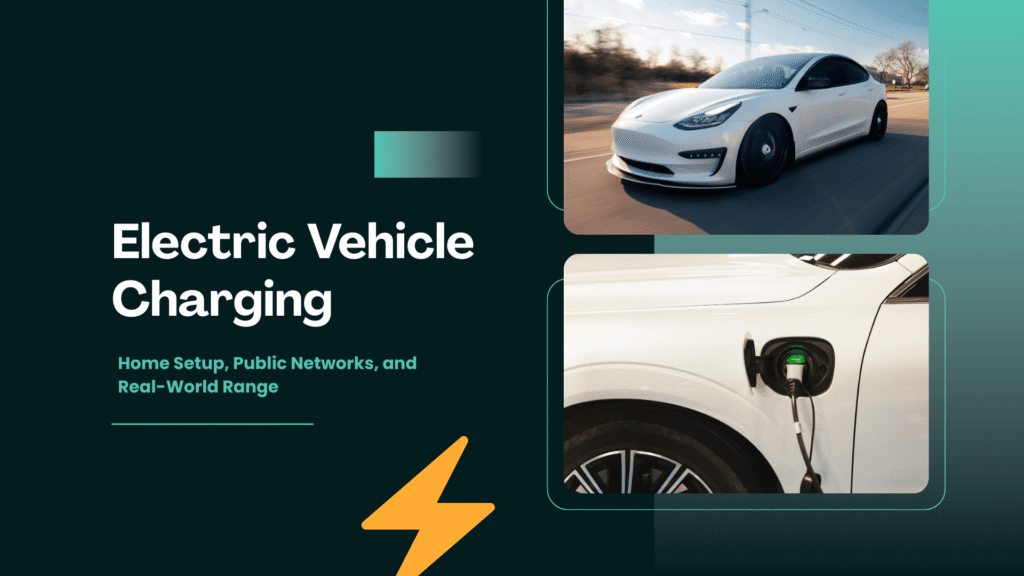
Electric vehicle charging is the practical reality that separates the EV ownership experience from the internal combustion ownership experience more than any other single factor — and it is the dimension that most prospective EV buyers research least thoroughly before purchase, producing the range anxiety, charging inconvenience, and infrastructure surprises that generate the negative ownership experiences that EV skeptics cite and that better pre-purchase understanding would have prevented or reframed. The charging infrastructure, home setup requirements, and real-world range considerations that determine daily EV ownership experience have each evolved enough in 2026 to make outdated information — particularly from 2020 and 2021 when charging networks were substantially less developed — a significant source of misaligned expectations in both directions. Understanding what EV charging actually involves in 2026 produces the accurate expectation calibration that makes EV ownership either clearly suitable or clearly unsuitable for a specific driver’s specific situation — which is more useful than the either the promotional enthusiasm or the infrastructure pessimism that dominate public EV charging discussion.
Home Charging: The Foundation That Makes EV Ownership Convenient
The EV ownership experience that most current owners describe as superior to gasoline ownership depends on a foundation that apartment dwellers and drivers without dedicated parking cannot access in the same form — home charging whose overnight replenishment makes the EV the only vehicle that arrives at the start of each day with a full “tank” without any active refueling stop. The driver who plugs in when arriving home and unplugs when departing in the morning is experiencing the charging convenience that makes range anxiety largely theoretical rather than practical for daily driving patterns whose distance is within the vehicle’s range.
The home charging setup that maximizes this convenience requires understanding the two levels of home charging and the installation that each requires. Level 1 charging — plugging the vehicle into a standard 120-volt household outlet using the charging cable included with most EVs — adds approximately 3 to 5 miles of range per hour of charging, sufficient to recover 30 to 50 miles of daily driving overnight but inadequate for drivers whose daily mileage is higher or whose charging window is shorter than a full overnight period. Level 2 charging — using a 240-volt circuit equivalent to the outlet a clothes dryer uses — adds approximately 15 to 30 miles of range per hour depending on the vehicle’s onboard charger capacity and the EVSE’s output rating, recovering a full battery overnight for most vehicles regardless of daily mileage.
The Level 2 home charging installation that most EV owners choose requires a dedicated 240-volt circuit installed by a licensed electrician and an Electric Vehicle Supply Equipment unit — the wall-mounted charging station that manages the charging session — whose combined cost ranges from $500 to $1,500 depending on the electrical panel’s proximity to the desired installation location, the panel’s capacity to add a dedicated circuit, and the EVSE unit selected. The federal Alternative Fuel Vehicle Refueling Property Credit that covers 30 percent of home EV charging equipment installation costs up to $1,000 reduces the net installation cost for qualifying installations — a credit whose availability most installers can confirm and whose application requires IRS Form 8911 at tax filing.
Public Charging Networks: The Infrastructure Whose Development Has Changed the Calculus
The public charging network whose inadequacy was the most legitimate EV ownership concern in 2020 and 2021 has developed substantially enough by 2026 to change the calculus for long-distance travel and urban drivers without home charging access — though with enough remaining geographic and reliability variation to warrant honest assessment rather than uniform optimism. The two categories of public charging — Level 2 public charging at destinations including shopping centers, parking garages, hotels, and workplaces, and DC fast charging at dedicated charging stations along highway corridors — serve different use cases whose understanding prevents the expectation misalignment that treating all public charging as equivalent produces.
Tesla’s Supercharger network — now open to non-Tesla vehicles through the North American Charging Standard adapter that most major non-Tesla EVs now support — remains the most reliable and most geographically comprehensive DC fast charging network in North America, whose consistent hardware maintenance, payment simplicity, and route planning integration through the Tesla navigation system and third-party apps including PlugShare have made it the benchmark against which other networks are measured. The competing DC fast charging networks — Electrify America, EVgo, ChargePoint, and the automaker-backed IONNA network — have improved reliability meaningfully from the 2021 to 2022 period when out-of-order charger rates were high enough to be a serious road trip planning concern, while maintaining enough variability in individual station reliability to make backup charging location planning a standard road trip practice for experienced EV drivers.
The practical road trip planning that DC fast charging enables in 2026 uses apps including PlugShare, ABRP (A Better Route Planner), and the integrated navigation of most current EVs to identify charging stops whose locations, network reliability ratings from recent user check-ins, and compatibility with the specific vehicle’s charging port standard and maximum charge rate determine the route that minimizes charging time while ensuring charge availability. The 15 to 45-minute DC fast charging stop that adds 150 to 200 miles of range — varying significantly by vehicle model, battery state of charge, ambient temperature, and charger output — is the road trip rhythm that experienced EV drivers have incorporated into trip planning in ways that the gasoline driver’s five-minute fill stop does not require but that the restaurant and rest stop integration that EV drivers have normalized makes more tolerable than the minutes-only comparison implies.
Real-World Range: What the EPA Estimate Does and Doesn’t Tell You
The EPA range estimate that appears on every EV’s window sticker is the figure that most prospective buyers use to evaluate whether a specific vehicle’s range is sufficient for their needs — and it is a figure whose relationship to real-world range under actual driving conditions is consistent enough in direction but variable enough in magnitude to require understanding before it becomes the basis for purchase decisions. The EPA test cycle that produces the range estimate uses controlled laboratory conditions — moderate temperature, moderate speed, minimal accessory use — that represent a subset of the driving conditions under which actual range is measured.
The real-world range reduction factors that produce the most significant deviation from EPA estimates are cold temperature, highway speed, and climate control use — whose individual effects are measurable and whose combination in winter highway driving at sustained high speeds with cabin heating active can reduce effective range to 50 to 70 percent of the EPA estimate for some vehicles. Cold temperature reduces battery capacity through the electrochemical limitations that lithium-ion batteries exhibit at low temperatures, with meaningful capacity reduction beginning around 32°F and more significant reduction below 20°F. The preconditioning feature that most current EVs provide — warming the battery to optimal operating temperature while still plugged in at home before departure — recovers a portion of the cold temperature range reduction by starting the trip with a thermally prepared battery rather than a cold one.
Highway speed’s effect on range reflects the aerodynamic drag that increases with the square of velocity — the EV that achieves its EPA range estimate at the 55 mph speed of the EPA test cycle covers meaningfully fewer miles at the 75 to 80 mph speeds that interstate highway driving involves. The practical rule of thumb that highway driving at 70 to 75 mph produces range approximately 15 to 25 percent below the EPA estimate provides a calibration that long-distance planning should incorporate rather than discovering through the range anxiety that approaching a charging stop with less remaining range than the EPA estimate predicted.
Charging for Apartment Dwellers and Drivers Without Home Charging
The EV ownership question that home charging’s convenience most clearly answers and that its absence most complicates is the daily charging routine for drivers whose housing situation does not include dedicated parking with electrical access. The apartment dweller, condo resident, and driver whose parking is street-based or in a shared facility without charging infrastructure faces the public charging dependency that makes EV ownership viable but less convenient than the home-charging experience that most EV ownership satisfaction data reflects.
The workplace charging that employers have increasingly installed — both as an employee benefit and in response to state and local government incentives — provides the destination charging that partially substitutes for home charging for drivers whose workplace offers it. The Level 2 public charging at grocery stores, shopping centers, and the destination charging networks at hotels whose installation rates have increased significantly provides the opportunistic charging that trip-integrated EV owners use to maintain charge without dedicated charging stops. The driver who reliably charges at work, supplements with destination charging at regular shopping locations, and uses DC fast charging for the occasional longer trip has constructed a charging routine that works without home charging — at higher inconvenience than the home charging baseline but at sufficient functionality for EV ownership to be practical.
Conclusion
EV charging in 2026 works well for drivers with home charging access, tolerable for urban drivers who construct charging routines from workplace and destination charging, and adequately for road trips whose planning incorporates the network reliability variation and real-world range factors that EPA estimates and network maps alone do not capture. The driver who understands home installation requirements and costs, plans road trips with network reliability data rather than charger count alone, and calibrates range expectations to actual driving conditions rather than EPA estimates is equipped to evaluate EV ownership suitability for their specific situation with accuracy that the promotional and pessimistic EV charging narratives each obscure in different directions.