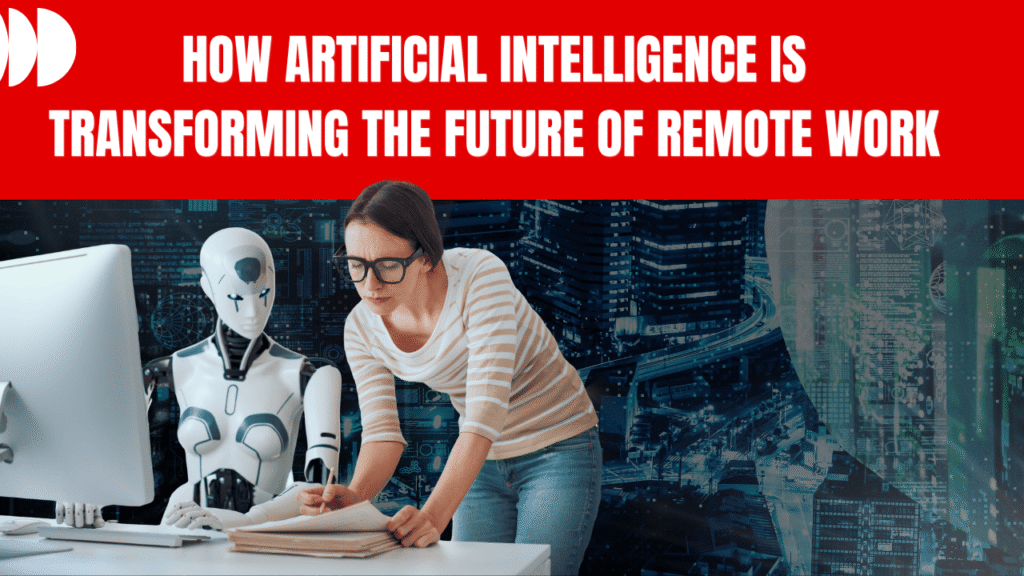
The intersection of artificial intelligence and remote work is producing changes whose significance exceeds the productivity tool adoption that most coverage of AI in the workplace focuses on — because AI is not simply making remote workers more efficient at the tasks they were already performing but is restructuring which tasks remote workers perform, how distributed teams coordinate, and what the competitive gap between AI-augmented and non-augmented remote professionals looks like in practice. Remote work and AI have developed in parallel in ways that make their combination more transformative than either would be independently — remote work created the digital-first work environment whose data trails, communication patterns, and workflow documentation AI systems can analyze and augment, while AI is resolving several of the coordination and visibility challenges that remote work created when it separated colleagues from the shared physical context that office environments provided. The remote work landscape that AI is reshaping in 2026 looks meaningfully different from the remote work of 2020 whose emergency adoption preserved office workflows in digital form rather than reimagining them for the distributed context.
AI Coordination Tools Are Solving Remote Work’s Core Problem
The fundamental challenge that remote work created — the coordination overhead whose resolution in office environments required proximity, ambient awareness, and the informal communication that hallway conversations and shared spaces provided — is the problem that AI coordination tools have made the most significant progress toward resolving. The meeting culture that remote work inherited from office environments and that the absence of physical coordination mechanisms made more rather than less meeting-heavy produced the Zoom fatigue and calendar fragmentation that characterized the first generation of remote work at scale. AI tools are restructuring this coordination overhead in ways whose cumulative effect on the remote work experience is more significant than any single tool’s individual contribution.
Asynchronous AI communication tools that generate meeting summaries, extract action items, identify decisions made, and distribute structured follow-ups have reduced the meeting necessity for the coordination tasks that synchronous attendance previously required. The project status meeting whose primary function was information distribution — updating participants on progress, decisions, and blockers — is the meeting type whose AI-generated equivalent produces the same information transfer without the scheduling coordination and synchronous attendance that the meeting format required. The teams whose coordination overhead has shifted from scheduled synchronous meetings toward AI-mediated asynchronous information sharing are reporting the calendar fragmentation reduction that the remote work meeting culture had made the most common productivity complaint.
AI project management integration — the tools that analyze project timelines, identify dependency risks, flag resource conflicts, and surface the coordination issues that distributed team visibility gaps previously left undetected until they became schedule-affecting problems — is the coordination augmentation whose value for remote team leads and project managers most directly addresses the remote work visibility challenge whose management required the check-in meetings that AI monitoring can replace. The remote team manager who previously scheduled weekly status meetings to maintain the project awareness that office proximity provided passively is managing with the AI-generated project health dashboard whose continuous monitoring produces the awareness that the weekly snapshot meeting provided at the fraction of the time cost.
AI Is Restructuring Which Tasks Remote Workers Actually Do
The task restructuring that AI is producing in remote work environments is most visible in the knowledge worker roles whose output is primarily information products — the documents, analyses, communications, and recommendations whose production AI assistance accelerates and whose quality AI augmentation improves in ways that are shifting the value contribution that remote workers are expected to provide. The remote worker whose AI tools handle first draft generation, research synthesis, data analysis, and routine communication is spending more of their working hours on the judgment, relationship, and strategic tasks whose AI augmentation is less complete — a task redistribution whose career implications for workers who adapt to the augmented role are positive and whose implications for workers who resist adaptation are increasingly visible in performance differentiation.
The software development transformation that AI coding assistance has produced in remote development teams illustrates the task restructuring dynamic most concretely because the productivity measurement is most precise. Remote development teams whose engineers use AI coding assistants including GitHub Copilot and Cursor are completing implementation tasks faster than teams without these tools — and the time recovered from implementation is being allocated to the architecture, code review, system design, and the cross-functional collaboration whose remote execution requires the deliberate effort that AI cannot automate. The remote developer whose AI tools handle the routine implementation that previously consumed the majority of their coding time is developing the higher-order technical judgment whose value the AI-assisted productivity baseline makes more visible relative to colleagues whose contribution is primarily implementation speed.
Remote Hiring and Evaluation Are Being Transformed by AI
The hiring processes that remote work requires — the candidate evaluation, skills assessment, and cultural fit determination that office-based hiring conducted through in-person interviews and observation — have developed AI augmentation whose implications for both candidates and employers are significant enough to change the preparation and strategy that remote job seekers require. AI-powered skills assessment tools that evaluate candidates through work sample tasks, coding challenges, and the asynchronous video interview analysis that automated screening platforms conduct before human reviewer involvement are producing the initial candidate filtering that resumes previously determined — with different biases, different accuracy profiles, and different candidate experience implications.
The remote worker whose application materials, skills assessments, and initial screening responses are evaluated by AI systems before human review is interacting with the AI hiring infrastructure whose understanding affects how their candidacy is positioned in the early stages where automated filtering determines whether human evaluation occurs. The candidates who understand that AI resume screening is keyword and format sensitive, that asynchronous video interview AI evaluates communication clarity and structure rather than the interpersonal qualities that in-person interview assessment weights more heavily, and that skills assessment AI is pattern-matching against defined competency criteria are preparing for the actual evaluation process rather than the human-centric evaluation process whose replacement by AI initial screening they have not yet updated their preparation for.
The Remote Worker Skill Set AI Is Making More Valuable
The skill redistribution that AI augmentation of remote work produces is creating a skill premium whose magnitude is increasing fast enough to make the development investments that capture it among the highest-return professional development decisions available to remote workers in 2026. The remote worker who can effectively direct AI tools — who understands how to structure prompts that produce useful outputs, how to evaluate AI-generated work for the accuracy and quality that the output requires, and how to integrate AI assistance into workflows without the quality degradation that uncritical AI adoption produces — is producing more and better work per hour than the equally talented worker without these capabilities.
The communication skills whose value AI augmentation increases rather than reduces are the distinctly human capabilities whose premium rises as AI handles the routine communication production that previously distinguished the high-output communicator from the average one. The remote worker whose AI tools generate first drafts, synthesize research, and produce routine communications is differentiating on the judgment, strategy, and relationship quality that AI assistance cannot replicate — the editing judgment that identifies which AI-generated content is accurate and appropriate, the strategic thinking that determines which questions the AI research should address, and the relationship intelligence that interprets the human context whose nuance the AI output cannot incorporate without human direction.
Conclusion
Artificial intelligence is transforming remote work at the coordination, task structure, hiring, and skill value levels whose combined effect is producing a remote work environment that resembles the 2020 digital office transition less than it resembles a genuine restructuring of how distributed work is organized and valued. The remote workers and organizations that are adapting to the AI-augmented remote work environment — using AI coordination tools to reduce meeting overhead, allowing AI task assistance to redistribute time toward higher-judgment work, and developing the AI direction skills whose premium the augmentation creates — are experiencing the productivity and career advancement benefits that the transformation makes available. The remote work future that AI is building is not the one that either remote work skeptics or enthusiasts anticipated in 2020 — it is more productive, more asynchronous, and more differentiated by AI capability than either projection anticipated.