
Europe’s most visited destinations have a problem that their popularity has created and that no amount of tourism management has fully solved — the crowds, the prices, and the sense of moving through an experience that has been packaged for visitors rather than lived by residents have made the most famous cities feel less like places and more like attractions. The traveler who has done Paris, Rome, and Barcelona and found them magnificent but exhausting is not wrong about what they experienced — they encountered destinations whose tourism infrastructure has become so dominant that the authentic life of the city exists in the margins of the visitor experience rather than at its center. The Balkans offer something that Europe’s most visited destinations have traded away in exchange for their fame — the texture of places that are still primarily lived in rather than primarily visited, at a cost structure that allows the kind of extended, unhurried engagement that the most meaningful travel requires. The region’s emergence as Europe’s most exciting travel destination is not a marketing repositioning — it is the discovery of a part of the continent that has been extraordinary all along and is only now receiving the attention that its qualities have always warranted.
What the Balkans Actually Contain That Most Travelers Don’t Know
The geographic and cultural range contained within the Balkan peninsula is extraordinary enough to challenge the assumption that European travel requires moving between multiple countries to encounter meaningful variety. Slovenia, Croatia, Bosnia and Herzegovina, Serbia, Montenegro, North Macedonia, Albania, Kosovo, and Bulgaria each carry distinct cultural identities, languages, culinary traditions, and historical layers that reflect the complex intersection of Ottoman, Austro-Hungarian, Byzantine, and Slavic influences that have shaped the region across centuries. The traveler who approaches the Balkans as a single destination underestimates the range it contains — the traveler who spends a month in the region barely scratches the surface of what it offers.
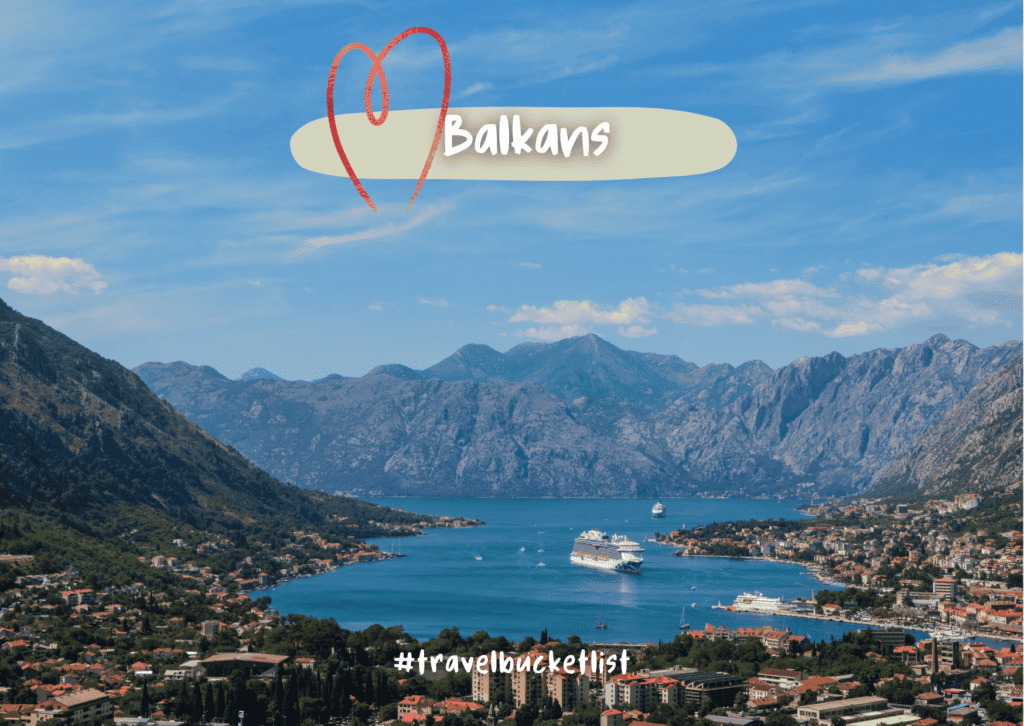
The coastline that Croatia’s Dalmatian region contributes to the Balkans’ travel portfolio is among the most spectacular in Europe — a succession of walled medieval cities, island-studded Adriatic waters, and national parks including Plitvice Lakes whose cascading turquoise pools and wooden walkways produce the kind of natural spectacle that images consistently fail to fully prepare visitors for. Montenegro’s Bay of Kotor compresses centuries of Venetian architecture into a mountain-ringed coastal setting that rivals anywhere in the Mediterranean for visual drama while carrying a fraction of the visitor volume that equivalent settings in Italy or Greece attract. Albania’s Riviera — still in the relatively early stages of international tourism development — offers coastal landscapes, ancient ruins, and the particular freshness of a destination that has not yet had its edges smoothed by the management that heavy tourism imposes.
Why the Pricing Makes Extended Exploration Genuinely Possible
The cost of travel across the Balkans is the practical dimension that transforms the region from a place serious travelers know about into one that changes how long they can afford to stay and how deeply they can afford to engage. With the exception of Croatia’s most popular destinations in peak summer season — Dubrovnik in particular, whose tourism pressure has brought its prices and crowds to levels that undermine its appeal in ways that increasingly motivate serious travelers to visit in shoulder season or seek alternatives — the Balkans provide a daily travel budget that allows quality accommodation, excellent food, local wine, and meaningful cultural experiences at costs that Western European destinations cannot approach.
Serbia and North Macedonia are among the most affordable destinations in Europe by any measure, with Sarajevo and Tirana offering comparable value for travelers willing to engage with destinations whose historical depth and cultural vitality deserve far more international recognition than their current visitor volumes reflect. The affordability is not a marker of diminished quality — it is a function of regional economics that allow a traveler to eat extraordinarily well, stay in genuinely beautiful accommodation, and move through some of the most historically significant landscapes in Europe at a daily cost that extends the travel horizon from a week to a month without requiring a budget revision.
The History and Culture That Rewards Serious Engagement
The historical depth of the Balkans is not the comfortable, curated history of destinations whose difficult periods have been processed into heritage tourism — it is the immediate, still-felt history of a region whose twentieth century was among the most turbulent in Europe and whose processing of that experience is still actively underway in ways that produce travel encounters of unusual emotional weight and intellectual substance. Sarajevo carries the layers of Ottoman and Austro-Hungarian history alongside the more recent history of the siege that shaped the city’s contemporary character and produced a population whose warmth toward visitors exists alongside a historical awareness that gives conversation in the city a particular depth.
The Roman ruins at Diocletian’s Palace in Split — the palace that became a city, whose walls were gradually inhabited until the palace and the town became inseparable — represent the kind of living historical integration that the Balkans produce repeatedly and that purpose-built heritage sites cannot approximate. Mostar’s rebuilt Stari Most bridge, the medieval walled city of Dubrovnik, the Byzantine monasteries of Serbia’s Žiča and Studenica, the Ottoman bazaar of Sarajevo’s Baščaršija, and the ancient ruins of Butrint in Albania are among the most significant historical sites in Europe and are experienced at visitor volumes that allow the kind of unhurried, unmediated engagement that the historical weight of each site deserves.
What the Timing of Discovery Means for the Traveler Going Now
The Balkans are in the phase of travel discovery that precedes the transformation that heavy tourism inevitably produces — the phase where the infrastructure is sufficient for comfortable independent travel, the destinations are accessible enough to reach without extraordinary effort, and the visitor volumes are low enough that the experience is still shaped primarily by the place rather than by the tourism apparatus that serves it. This phase is finite in the destinations that attract serious traveler attention, and the trajectory of Balkans tourism — already visible in Dubrovnik’s overcrowding and in the growing international profile of Ljubljana, Kotor, and Tirana — is toward the increased visitor volumes that will eventually change what the region currently offers.
The traveler who goes now encounters the Balkans at a moment when the combination of accessible infrastructure, low visitor volumes, extraordinary natural and cultural content, and the pricing that makes extended engagement possible is simultaneously present in a way that the trajectory of the region’s tourism development suggests will not persist indefinitely. The destinations within the region that are furthest from that trajectory — Albania, Kosovo, North Macedonia, and the interior of Bosnia — offer the most complete version of what the Balkans provide before the discovery curve reaches them, and the travelers who engage with these destinations now are making the kind of timing decision that the most experienced travelers consistently identify as the most valuable one available.
Conclusion
The Balkans are emerging as Europe’s most exciting travel region because the combination of extraordinary cultural and natural content, genuine historical depth, pricing that enables extended serious engagement, and visitor volumes that have not yet transformed the experience into managed tourism is available in a single region with the geographic and cultural variety that most travelers require an entire continent to access. The region rewards the traveler who brings genuine curiosity and the willingness to engage with history and culture that is immediate rather than packaged — and delivers to that traveler an experience whose quality and authenticity the more famous European destinations have increasingly traded away in exchange for their fame. Going now, while the conditions that make the Balkans extraordinary are still intact, is the travel timing decision that the evidence supports most clearly.